Best HVAC Schools.com

Best HVAC Schools in Phoenix, AZ (2026)

Phoenix is the most HVAC-concentrated large metro on this site, employing the trade at 29 percent above the national rate, and it is the only one of the four where the median beats the national median. It also holds about three quarters of Arizona's HVAC jobs and the only accredited HVAC program in the state, at GateWay Community College. Arizona licenses contractors and not technicians, so what Phoenix adds is not a licence but a set of mechanical code amendments the city wrote because of the heat.

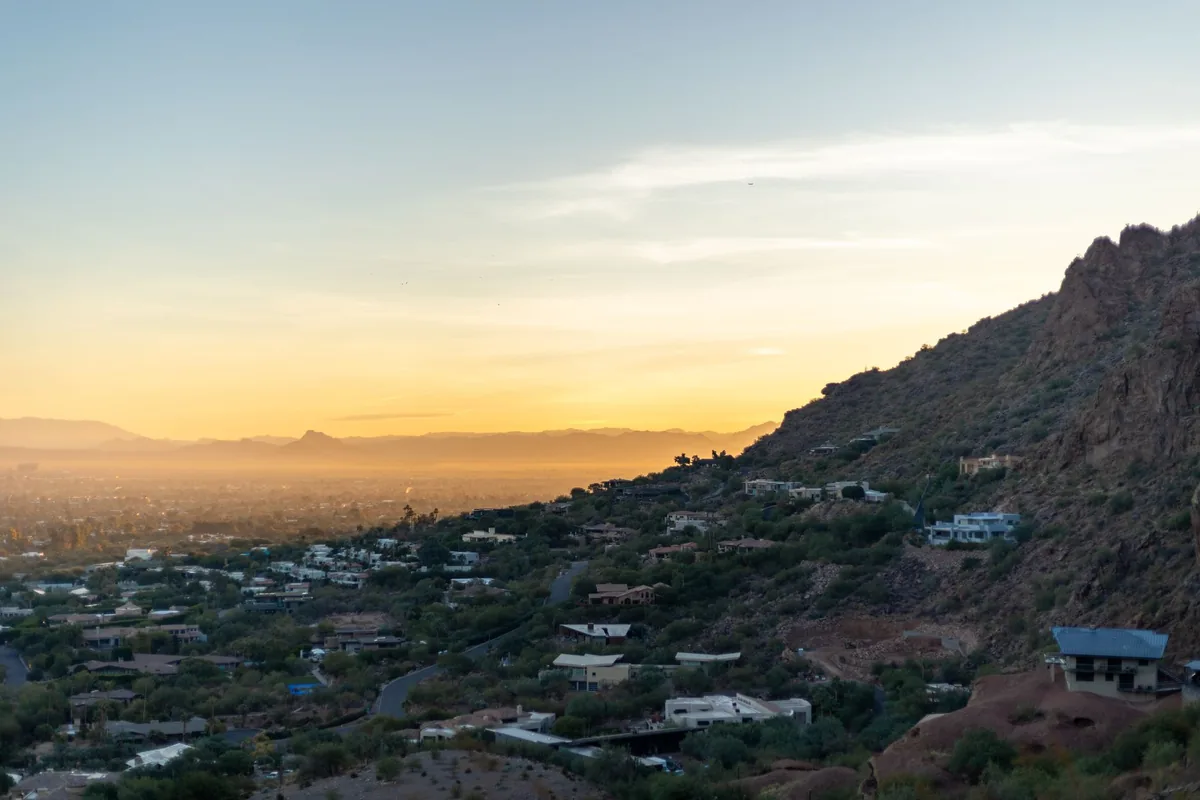
Sunset over the Phoenix valley seen from high on a desert mountainside, houses set among scrub along the slope on the right and the flat city spreading to distant ranges on the left
The Phoenix valley at sunset from the desert slopes. Photo by Nicole Seidl, licensed under the Pexels licence, via Pexels.
1 Accredited programs in metro
$61,170 Median wage, Phoenix metro
8,070 HVAC jobs in metro
1.29 Jobs vs national rate

Local layer: City amendments to the mechanical code, no city licence


On this page

HVAC programs

Accredited HVAC schools and programs in Phoenix

The Phoenix metro has 1 accredited HVAC program accredited by HVAC Excellence or PAHRA. Ranks are national: a program shown at 6th sits 6th among all accredited HVAC programs in the country, not 6th in Phoenix. It names EPA Section 608 preparation where it describes the program. The metro follows the Bureau of Labor Statistics definition, covering Maricopa and Pinal counties, so a program listed here may sit some way outside the city itself. Each card names the campus.

#1

Gateway Community College

Phoenix, AZ ยท Public Post-Secondary

85/100 ranking score
Credential Associate's
Accreditation PAHRA , Partnership for Air-Conditioning, Heating, Refrigeration Accreditation
EPA 608 prepOSHAEvening or part-time

Arizona asks nothing of a technician on someone else's payroll, so a Gateway graduate can take the Air Conditioning/Refrigeration/Facilities AAS straight to work with no state credential to chase. The degree earns its keep later instead: the state counts up to two years of college or manufacturer accredited training toward the four years of experience a contractor license requires, so classroom time now can shorten the wait if you eventually want the business to be yours.

Course content goes past the residential basics into hydronics, electricity, and general repair, and the program's stated outcomes are pointedly commercial, from diagnosing faults in commercial HVAC/R equipment to troubleshooting systems using technical documents. Refrigerant credentials come early too, with the EPA Section 608 preparation and certification course sitting in the second term of both the full-time and part-time sequences.

Part-time students ramp up gradually, spending the first term on safety, construction calculations, and construction drawings before the opening HVAC course arrives in term two. Everyone is steered toward an individual education plan built with an advisor, and a Maricopa district first-year experience course may be required within the first two semesters. Pipeline AZ counts 10,810 projected job openings for HVAC mechanics and installers, lists a postsecondary certificate as the typical education level, and puts mid-level pay at $47,590.

Sources: Arizona HVAC school program, EPA Section 608, IPEDS.

In this metro: Phoenix

Willing to travel? Compare these HVAC programs in Phoenix against every accredited program in Arizona, or against the best HVAC schools and programs nationally.

Where the heat rewrites the code

What Phoenix mechanical code amendments affect HVAC work in 2026?

Phoenix amends the 2024 International Mechanical Code with its own provisions, adopted by city ordinance G-7397 and effective 1 August 2025, and the amendments that matter most to a technician were written because of the weather. The clearest is the condensate rule. Section 307.2.2 as amended states that nonmetallic piping shall not be installed in exposed locations, which in practice means no plastic condensate line running across a roof in the sun.

The city set out its reasoning in the amendment itself, and it is a good description of the job here. Nonmetallic piping subject to extreme heat softens and sags between its supports, which creates low spots that stop gravity flow to the point of disposal, and ultraviolet exposure makes the pipe brittle enough to fracture under stress. The failure mode it is guarding against is water ponding on a roof. Condensate drain lines must also be at least three quarter inch and may not reduce in size from the drain pan onward.

A second amendment governs refrigeration machinery rooms. Section 1105.10 as amended requires unobstructed walking space at least three feet wide and six feet eight inches high maintained throughout, giving free access to at least two sides of all moving machinery and to each stop valve, with access restricted to authorised personnel and permanent signage posted. That is a service clearance rule, written from the point of view of the person who has to work in the room rather than the person installing the equipment.

Cooling as a code requirement

Does Phoenix require air conditioning in occupied buildings in 2026?

Phoenix requires cooling in occupied buildings, which the base mechanical code does not. The city amended section 309.1 to cover heating and cooling systems rather than space heating alone, and interior spaces intended for human occupancy must have systems capable of maintaining an indoor temperature between 70 and 82 degrees Fahrenheit. Portable heaters and coolers do not count toward compliance. The city recorded the cost impact of this amendment as significant, and noted that the base code does not require cooling at all.

The interesting part is the exception written into the same sentence. Where a space is cooled by evaporative cooling rather than refrigerated air, the requirement is 86 degrees rather than 82. Phoenix is dry enough that evaporative cooling remains a real system type rather than a curiosity, and the code accepts that it will not hold the same indoor temperature as a compressor. A technician trained only on refrigerated air is trained on part of this market.

Evaporative equipment gets its own section as a result. Section 928 sets out installation on level platforms, flashing where the unit passes through a wall or roof, an approved water supply sized for peak demand with water quality per the manufacturer, protection of the potable supply under the plumbing code, and a permanent relief opening to balance intake air. The city tied the cooling requirement itself back to its Neighborhood Preservation Ordinance, on the reasoning that any new building may eventually be rented.

Phoenix section 309.1, what a system must be able to hold
Refrigerated air 82 Evaporative cooling 86

Working in the heat

What heat protections do Phoenix HVAC workers have in 2026?

Phoenix adopted a workplace heat safety ordinance in March 2024, G-7241, which added section 18-411 and following to the city code and took effect on 25 April 2024. Its reach is narrower than it is often reported to be, and the limit is worth understanding: it applies to contractors who retain people working outdoors under a City of Phoenix contract, lease or licence, rather than to every employer in the city. The requirements also flow down the chain into subcontracts.

Covered employers must provide free cool drinking water, breaks for hydration as needed, and access to shade or air conditioning. They must run effective acclimatisation practices for anyone newly assigned to outdoor work, which is the provision aimed squarely at a new technician's first summer. They must make training available on the risk factors, prevention, signs and symptoms, first aid and reporting of heat illness. Vehicles with enclosed cabs were required to have working air conditioning by 1 May 2025.

The council amended the ordinance in February 2026 to add protection against retaliation and new reporting duties, and to require contractors to keep logs showing that vehicle air conditioning works. Enforcement runs through the contract rather than through fines: a contractor out of compliance can have its city contract cancelled or suspended, or be suspended or debarred. If you are working residential service for a private company in Phoenix, none of this binds your employer, and that gap is the reason to read it carefully rather than assume you are covered.

One school, most of the state

Where can you train for HVAC in Phoenix in 2026?

Phoenix holds the only accredited HVAC program in Arizona, at GateWay Community College, which is accredited by PAHRA. For a metro of this size that is a thin supply of accredited training, and it is thinner still when you notice how much of the state's work sits here: the Phoenix metro employs 8,070 HVAC technicians out of 10,860 in Arizona, so roughly three quarters of the state's HVAC workforce is inside this one metropolitan area.

The concentration figures say the same thing from the other direction. Phoenix has 3.395 HVAC jobs per thousand jobs of all kinds, and a location quotient of 1.29, meaning it employs this trade at 29 percent above the national rate. That is the highest concentration of the four cities covered here, ahead of Miami at 1.23, Las Vegas at 1.05 and Houston at 0.89. Phoenix is not simply a big city that happens to need cooling, it is a city where this trade is a disproportionate share of the work.

Arizona requires no licence to work as an HVAC technician for someone else, so training here is about employability and about the C-39 or CR-39 contractor licence later rather than about a permission slip to start. The Arizona page covers how school counts toward that licence.

How concentrated each metro is in this trade
Phoenix 3.395 Miami 3.242 Las Vegas 2.767 Houston 2.334

Sources: PAHRA.

Phoenix pay

How much do HVAC techs make in Phoenix in 2026?

HVAC techs in the Phoenix metro make a median of $61,170 a year, which is $1,770 above the Arizona median of $59,400 and $160 above the national median of $61,010. Phoenix is the only one of the four cities on this site whose median clears the national figure, and it does so on the largest HVAC workforce concentration of the four. The hourly median is $29.41.

The range runs from $38,210 at the bottom tenth to $83,180 at the top tenth, with the middle half between $47,430 and $74,880. The floor is the lowest of the four cities here, slightly below both Houston and Miami, so the strong median is not coming from the bottom of the market being lifted. It comes from the middle and upper middle: Phoenix's 75th percentile of $74,880 is second only to Las Vegas among the four, and it clears both Houston and Miami.

The ceiling behaves like the others. At $83,180 the Phoenix 90th percentile sits about $12,000 under the national 90th percentile of $95,210, so the very top of this trade is still elsewhere. What Phoenix offers is a strong middle on a great deal of work. These figures come from the Bureau of Labor Statistics wage survey of May 2025 for occupation 49-9021, covering the Phoenix-Mesa-Chandler metropolitan area, which is Maricopa and Pinal counties.

Phoenix metro Arizona Annual wage by percentile, Phoenix against Arizona and the nation
10th $38,210 $37,950 25th $47,430 $47,170 Median $61,170 $59,400 75th $74,880 $73,810 90th $83,180 $80,160

Sources: BLS OEWS.

Pay detail

Phoenix HVAC pay against Arizona and the nation

Phoenix HVAC pay runs from the bottom tenth to the top in the table below, beside the same percentiles for Arizona and for the country. All figures are annual, from the Bureau of Labor Statistics OEWS release of May 2025 for occupation 49-9021. The metro column covers Maricopa and Pinal counties, which is wider than the city.

Percentile Phoenix metro AZ United States
10th $38,210 $37,950 $40,050
25th $47,430 $47,170 $48,360
Median $61,170 $59,400 $61,010
75th $74,880 $73,810 $77,060
90th $83,180 $80,160 $95,210

8,070 HVAC jobs in the Phoenix metro, 1.29 times the national employment rate. OEWS is a wage survey and carries no employment projections

Sources

Where our Phoenix HVAC data comes from

Our Phoenix HVAC school and licensing data comes from the sources below, each one linked so you can check it: the city or county's own code, ordinance and permit schedule for the local rules, the state board or statute for licensing, the Bureau of Labor Statistics for wages, and each school's own published program page. Local research was verified 2026-08-10.

City of Phoenix amendments to the 2024 International Mechanical Code
phoenix.gov
City of Phoenix building construction codes
phoenix.gov
City of Phoenix worker safety ordinance
phoenix.gov
Phoenix City Code section 18-413, requirements of contractors
phoenix.municipal.codes
Arizona Registrar of Contractors, licence classifications
roc.az.gov
Arizona licensing
Our Arizona licensing research

Local research verified 2026-08-10. Codes and ordinances change, so confirm with the city or county before relying on them

Arizona licensing

HVAC schools and licensing in Arizona

Everything on this page sits on top of Arizona licensing, which is where the credential itself comes from. The Arizona page covers the licence tiers, what they require, how much of that requirement schooling can replace, and every accredited HVAC program in the state rather than only those in the Phoenix metro.

Arizona HVAC Schools and Licensing 1 accredited program statewide

Other cities

HVAC schools and programs in other cities

HVAC schools and programs in other cities are worth comparing, because the local layer changes at the county line even where the state licence does not. Each page below covers what that city adds to its state's rules, its metro pay, and the accredited HVAC programs within reach of it.

A city appears here once its local rules have been read from the city or county's own code, and once there is an accredited program within reach of it. See all HVAC schools and programs by state or the national ranking.